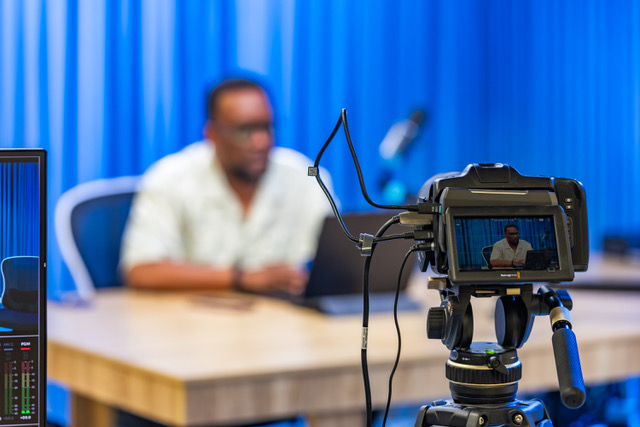
Carel Pedre has been in media for more than 20 years, starting as a radio host and journalist in Haiti. His passion for storytelling, music, and digital content led him to create Chokarella, a platform dedicated to showcasing Haitian culture, music, and impactful stories. Originally launched as a morning show, it has grown over the years into a full-fledged digital media brand, producing a wide variety of programming, including live interviews with musicians, entrepreneurs, and influencers; live broadcasts via a daily radio show and video podcast; music sessions and behind-the-scenes content; and event coverage featuring documentary-style storytelling.
With content distributed to hundreds of thousands of followers across YouTube (long form interviews, special features), Instagram, Facebook, TikTok (short clips, highlights), and the Chokarella app and website (exclusive content and live streams), Pedre relies on a production and post workflow backed by Blackmagic Design products.
Breaking New Ground
Pedre’s first foray into the world of Blackmagic Design began in Haiti with a Pocket Cinema Camera 4K, and during the pandemic, he was quick to upgrade to a full Blackmagic Design workflow for live streaming, powered by an ATEM Television Studio HD live production switcher, HyperDeck broadcast recorders, Video Assist monitors/recorders, and an ATEM Streaming Bridge converter.
With its first studio located in Haiti, Chokarella recently established a new studio in Fort Lauderdale, FL, expanding the brand into the U.S. and reaching a wider audience. “We branched out to better serve the Haitian community by extending our production capabilities in the upgraded Fort Lauderdale studio, effectively reaching audiences globally with the enhanced workflow,” said Pedre.
The Fort Lauderdale studio features three Blackmagic Cinema Camera 6Ks and six Pocket Cinema Camera 6K G2s, DaVinci Resolve Studio editing, color grading, visual effects (VFX) and audio post production software, and ATEM Mini Pro ISO and ATEM Mini Extreme ISO live production switchers.
“We needed a production setup that could deliver broadcast-quality visuals, be cost effective, and integrate seamlessly with live streaming and multi-camera recordings,” said Pedre. “The Blackmagic gear checked all those boxes, providing cinema-quality imaging without the price tag of other high-end systems. We love the high dynamic range and color science in the Blackmagic cameras, which give us rich visuals, and the ATEMs’ live switching capabilities are perfect for real-time production as they integrate so smoothly into our workflow.”
Following the Process
Each project follows a structured pipeline: pre-production (research, scripting, guest coordination), production (multi-camera recording using the cameras and switchers, post production (color grading, editing and audio mastering in DaVinci Resolve Studio), and distribution and promotion (publishing on digital platforms, social media clips).
For production, the cameras are set up with LUTs and fed into an ATEM Mini Extreme ISO for multi-camera control and ISO recording. For Chokarella’s pre-recorded content, each camera records Blackmagic RAW files in 6K onto hard drives for maximum quality. Footage is edited and color graded in DaVinci Resolve Studio before being exported in 4K. For live streaming, an ATEM Mini Extreme ISO’s built-in hardware streaming engine handles the live stream directly, providing a seamless production workflow.
Getting Reliable Results
According to Pedre, the Blackmagic Cinema Camera 6K and Pocket Cinema Camera 6K G2 have had an extensive impact on Chokarella’s productions by allowing the team to quickly deliver high-quality videos, even those that incorporate multi-camera live switching.
“The Blackmagic Cinema Camera 6K is my main workhorse for anything cinematic,” said Pedre. “I use it for interviews, all published in 4K, because it gives me that rich, detailed image with tons of depth. It’s also my go-to for music sessions and documentary-style content because the color flexibility and overall image quality are next level.”
He continued, “The open gate recording is another huge plus. It lets me capture the entire sensor, so I can reframe in post without losing quality. This is a lifesaver when I need to repurpose content for different aspect ratios like 16:9, 9:16, or 1:1. Plus, the built-in ND filters make shooting outdoors or under studio lights a breeze. The Pocket Cinema Cameras are usually secondary cameras in our multicam setups. They’re perfect for wide shots or mid shots during live streams.”
Both the ATEM Mini Pro ISO and ATEM Mini Extreme ISO are staples in the workflow, and Pedre appreciates how he can use them for different purposes. “The ATEM Mini Pro ISO is my choice for smaller, simpler setups like one-on-one interviews, solo content creation, podcast recordings, or pre-recorded segments where I don’t need a ton of inputs,” he said. “It’s great for quick, straightforward setups with two to three cameras. For bigger multicam productions, I rely on the ATEM Mini Extreme ISO. It’s perfect for live streams, panel discussions, concerts, and events with multiple angles. With eight inputs, it’s my go-to for anything that requires a more robust live production workflow.”
In post production, Pedre commends DaVinci Resolve Studio’s suite of editing, color correction, and audio post production tools. “We use Resolve for color correction and grading to maintain a consistent aesthetic,” he said. “We also use its multicam editing to streamline interview cuts and Fairlight audio post tools to enhance clarity and reduce noise.”
Pedre handles most of the day-to-day editing, since DaVinci Resolve Studio makes it easy to work with files straight from the ATEM switchers. For bigger projects, he works with two additional editors to finalize the edit, color grade, and export.
“In Resolve, I love using multicam editing because it makes syncing and cutting between multiple Blackmagic camera feeds so easy, especially when we’re not using an ATEM Mini,” said Pedre. “The Fusion VFX page in Resolve is great for motion graphics like lower thirds, and Smart Reframe is a total game changer for repurposing content from 16:9 to 9:16 or square formats for Instagram, TikTok, etc.”
For audio post production in DaVinci Resolve Studio’s Fairlight page, Pedre relies on dialogue leveling and noise reduction to clean up interviews and live recordings. “EQ, compression, and voice isolation are essential for keeping the audio sounding consistent and professional, and I use EQ adjustments to fine-tune vocals and make them pop,” he concluded.

- RockPoint Church Chattanooga Elevates Attendee Experience with Blackmagic Design - January 22, 2026
- Van Cliburn International Piano Competition Uses Blackmagic Design - December 24, 2025
- LittleBig Transforms African Energy Week Content Delivery - December 2, 2025