Since 1986, Auditel has been Italy’s reference point for television audience measurement, providing viewing data for broadcasters and the wider advertising market. The company recently turned to creative agency Coo’ee Italia to create a campaign that would convey that role in an original way.
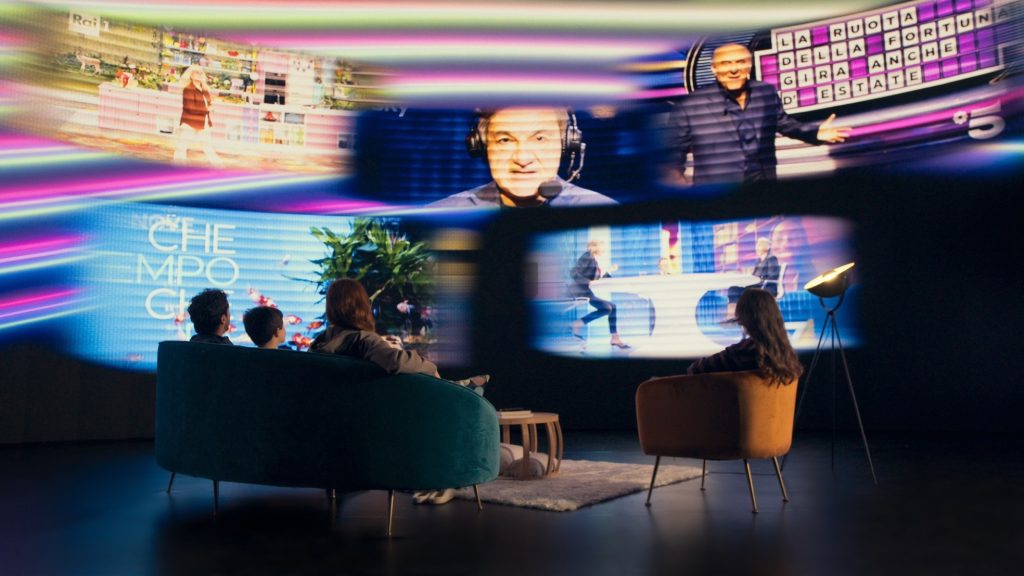
A simple metaphor drives the campaign created by Alessandro Tosatto: a typical Italian family portrayed in a stylized living room, watching programming from RAI, Mediaset and Sky played on a huge screen. “The idea was to let the screen content light the space and play across the actors,” Tosatto said. “That was our way of showing Auditel in everyday Italian homes.”
DP Alessandro Zonin (AIC, IMAGO) shot the campaign on the Blackmagic PYXIS 12K digital film camera, with post production in DaVinci Resolve Studio. “The commercial was shot on an LED volume stage at STS Communication in Milan,” revealed Zonin.
The studio’s large LED wall is driven by a playback system designed for high resolution content. “One of the biggest challenges was balancing the actors against the wall in camera,” Zonin explained. “With the background baked in, we had to carefully manage exposure, color and contrast because there was limited room to fix it in post production.”
To create the projection of images onto the actors’ faces, Zonin used a 1700 ANSI lumen UltraHD video projector and matched it to the wall playback. “The light from the LED screen was diffused, but the projection was not sufficiently defined on the actors’ faces. By using a projector, we were able to achieve a much more penetrating effect,” noted Zonin. “They were lit low with bounce and slightly underexposed. At the same time, it was essential to keep the background projection readable against the LED wall’s brightness.”

“The PYXIS 12K’s exposure latitude helped hold highlight detail on the wall while keeping skin tones workable,” said Zonin. “Paired with XEEN Meister T1.3 lenses, we shot around T2.8 at 800 ISO which helped to maintain depth of field and subject separation against the bright wall.”
He added, “On deliberately underexposed faces, the camera’s RGBW sensor gave us cleaner luminance and less chroma noise when lifting.”
The campaign was shot in 12K 3:2 open gate at 25fps to afford greater creative freedom in post production, recording in Blackmagic RAW 3:1 constant bitrate on CFexpress media. Rigged on sticks, the camera was equipped with a wireless follow focus external monitoring, and wireless video transmission links (Vaxis Storm 3000) feeding monitors at the video village.
LED Wall Matching in DaVinci Resolve Studio
On set DIT and Colorist Sergio Cremasco worked with Editor Michele Montresor entirely in DaVinci Resolve Studio.
The camera remained locked off, with reframes, pushes and handheld style shake created in post production. “The decision to shoot 12K open gate allowed me to punch into closeups directly from the wide shot, zooming in, reframing and adding subtle shake to simulate the idea of handheld camera movement without losing the quality of the details,” explained Montresor.
He added that the proxy workflow made it easier to build the cut and test those reframes quickly: “I used the in camera H.264 proxies for the first rough cut and image selection, then switched to the full resolution originals to check the effect and quality.”
According to Cremasco, the main challenge was the credible integration between the LED wall and the actors on stage. “On set, I matched exposure, white balance and color between the LED volume and the subjects, defining in DaVinci Resolve how the wall’s output should sit against the camera’s response,” he said. “This got us close on set, which meant in the grade we could focus on integration and look.”

“In a production of this kind, it doesn’t take much for the background to be perceived as a screen. Too much color cast, mismatched contrast or blacks that do not sit naturally all can have an effect,” Cremasco continued. “Skin can also pick up spill from the wall and shift between takes, making it difficult to maintain visual consistency.”
Working in DaVinci Wide Gamut, Cremasco could keep subjects and background consistent and carry that through to the final output transform. “In this color space, I could control the relationship between subjects and background, refine subtle shot to shot differences and finalize the look, while maintaining predictable levels and color through to delivery,” he explained.
Cremasco relied on a node tree to separate base balance, wall and environment integration, and subject refinements. “For general alignment, I worked with primary color wheels and log wheels to adjust exposure, contrast and balance, constantly checking on vectorscope to ensure that levels remained consistent between shots,” he noted. “To address the more subtle color variations, I used custom curves and Hue Vs Hue and Hue Vs Sat Curves, shaping the tonal response of the background without altering the appearance of the subjects.”
“For skin tones, I used HSL qualifiers and Power Windows to isolate the face, then nudged hue and saturation to keep complexions natural when the LED wall threw color casts or reflections,” he added.
LED volumes can introduce flicker, banding and moiré. “In this case, while actively monitoring these risks, the Blackmagic RAW codec and RGBW sensor response gave me enough flexibility to manage both the saturation and luminance of the LED without ruining skin tones or overly the compressing contrast levels,” he continued.
“That reduced the amount of corrective work needed to make the wall and subjects match,” he concluded.
Press Photography
Product photos of PYXIS 12K, DaVinci Resolve Studio and all other Blackmagic Design products are available at www.blackmagicdesign.com/media/images.
About Blackmagic Design
Blackmagic Design creates the world’s highest quality video editing products, digital film cameras, color correctors, video converters, video monitoring, routers, live production switchers, disk recorders, waveform monitors and real time film scanners for the feature film, post production and television broadcast industries. Blackmagic Design’s DeckLink capture cards launched a revolution in quality and affordability in post production, while the company’s Emmy™ award winning DaVinci color correction products have dominated the television and film industry since 1984. Blackmagic Design continues ground breaking innovations including 6G-SDI and 12G-SDI products and stereoscopic 3D and Ultra HD workflows. Founded by world leading post production editors and engineers, Blackmagic Design has offices in the USA, UK, Japan, Singapore and Australia. For more information, please go to www.blackmagicdesign.com.

- Auditel Ad Campaign Shot on Blackmagic PYXIS 12K - March 13, 2026
- Kochi Sun Sun Uses Blackmagic Replay for High School Volleyball Finals - March 13, 2026
- ATEM Television Studio 4K8 Powers Sports Illustrated FC - January 29, 2026