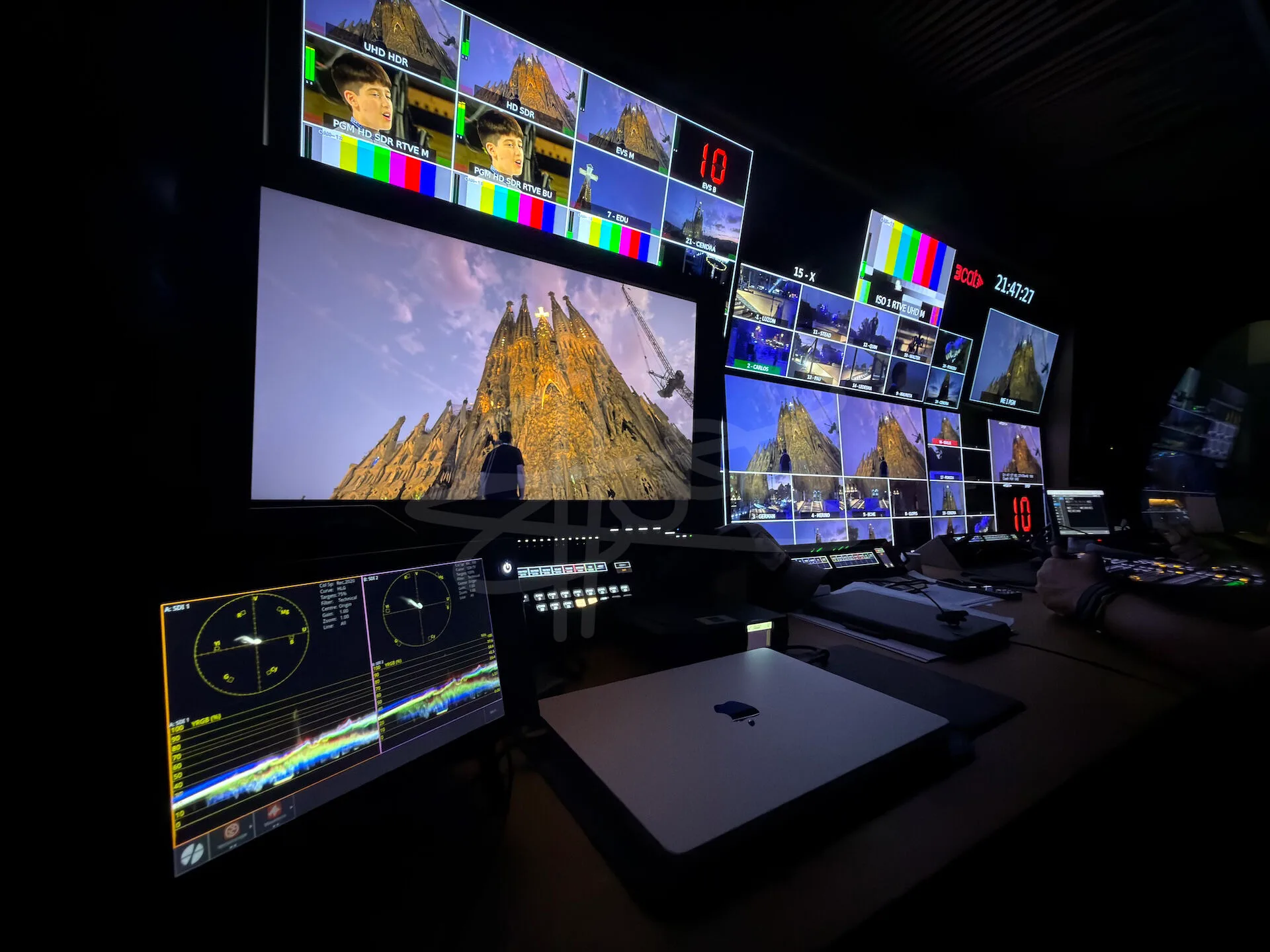
Two days of load-in and a basilica that has been under construction for 144 years is not the usual OB footprint, but that was the brief for Catalan broadcaster 3Cat (TV3) when Pope Leo XIV visited Barcelona's Sagrada Família on June 10. The live UHD/HDR production covered both the interior and exterior of the church for a global feed timed to the centenary of architect Antoni Gaudí's death and the completion of the Tower of Jesus Christ, the 172.5-meter centerpiece now described as the world's tallest church tower. On the measurement side of that show, broadcast engineering consultant Hector Sole-Bradshaw Beltran - technical director for the project - leaned on tools he already treats as standard kit: a PHABRIX Qx rasterizer and a LeaderPhabrix LPX500 waveform monitor from Leader Electronics of Europe.
The artistic brief came from artistic director Igor Cortadellas and production director Pauli Subira Claramunt. Their approach mixed conventional high-end live craft with cinematographic technique, including Sony Cinema Line cameras that Sole-Bradshaw said had not previously been used in a European international UHD/HDR live broadcast of this type. That mix forced a practical problem for engineering: keep Tier One broadcast discipline while absorbing digital cinematography signal behavior, color science, and monitoring needs inside a single live plant. Cost of UHD/HDR was secondary to archival and distribution value. "Regardless of the cost that UHD/HDR might have [for an event like this], the importance of the production and the relevance in terms of archival and distribution is so large that it doesn't really matter if it's more expensive," Sole-Bradshaw said, framing the main hurdle as unifying broadcast engineering requirements with digital cinematography tools.
Portable rasterizer duty in a constrained basilica plant
Sole-Bradshaw describes the PHABRIX Qx as a unit he always brings to production. On this show he ran it from a V-Lock battery so it did not need mains at a fixed bench. That battery-backed mobility mattered inside Sagrada Família's architectural constraints, where camera positions, light levels, and HDR/SDR mix shifted across interior and exterior looks. "What I tend to do is have a V-Lock battery powering the unit, so I don't need to have it plugged into mains, and that allows me to move to different places in the engineering footprint and do the required testing and analysis," he said. In practice, that put advanced analysis next to the camera chains that needed it rather than locking QC to a single rack position in an already tight load-in window.

The LeaderPhabrix LPX500 sat beside that workflow as a quad 4K-input hybrid IP/SDI waveform monitor. This particular production stayed on SDI - four 12G-SDI signals into the LPX500, with no IP element in the plant. Sole-Bradshaw used it to display and monitor cameras during rehearsals and the show, covering both HDR and SDR sources. "I was able to check a camera anytime during the show or rehearsals, including both HDR and SDR sources. Again, it's another item of very reliable equipment that helped make the production run smoothly," he noted. For a two-day build that had to clear artistic and engineering sign-off before a once-only papal visit, that kind of anytime camera check is less luxury than insurance.
What the T&M layer actually protected
UHD/HDR live work with cinema-line cameras raises failure modes that SD-era metering does not catch: wrong transfer characteristics on a source, mismatched HDR/SDR monitoring, illegal levels on long lenses in mixed lighting, and last-minute camera adds that never see a full line-up. A portable Qx and a multi-input LPX500 do not invent creative looks, but they keep those looks legal and consistent when the artistic plan spans interior stone, exterior daylight, and ceremonial pacing. Sole-Bradshaw's choice to keep both units in the footprint, rather than depending only on truck-based scopes, also matches how modern high-end OBs often split engineering attention across multiple zones when the venue itself is the set.
The political and religious sensitivity of the day added another constraint. The technical team could not treat the production as a pure sports-style spectacle. Sole-Bradshaw said one of the hardest parts of contemporary large events is landing a production that works across different political and religious expectations. On June 10 the solution was visual focus on the building. "By focusing on the building itself, which is outstanding and unique in the world, it was one of those occasions where there was universal acclaim and people were left with a really beautiful memory of the day," he said. That framing is useful for engineers as well as producers: when the narrative centers on architecture and light, camera exposure, HDR highlight handling, and clean long-shot detail become part of the storytelling, not just compliance.
Leader's presence on the credit line is straightforward kit history rather than a product launch. The Qx and LPX500 were in the hands of a technical director who already trusts them on Tier One work and who needed battery-portable analysis plus multi-12G monitoring inside a two-day basilica load-in. For readers planning similar hybrid cinema-plus-broadcast events - papal visits, cathedral concerts, national ceremonies - the operational takeaway is the pairing: keep a high-end rasterizer mobile enough to walk the plant, and keep a multi-input waveform monitor on the 12G paths that actually feed the show. The Tower of Jesus Christ may take another decade before the Sagrada Família is fully complete, but the June 10 UHD/HDR feed had to be finished in two days. On that clock, T&M that can move with the problem is as much production infrastructure as any camera head.
News submitted by: Fiona Blake