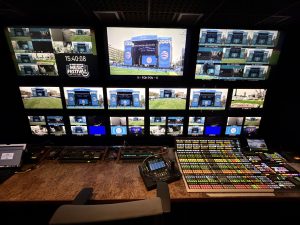
ASHVILLE, May 11, 2026 — TNDV and sister company Live Media, both divisions of Live Media Group, once again played a central role in delivering live broadcast coverage surrounding NCAA Final Four weekend, supporting both large-scale concert productions and live game-related programming across multiple platforms. Marking its 13th consecutive year supporting the March Madness Music Festival, TNDV deployed a multi-truck mobile production ecosystem to capture, mix and deliver three days of live performances, while also expanding its footprint inside Lucas Oil Stadium for a first-of-its-kind in-game concert broadcast.
Outside the stadium, TNDV’s Aspiration 40-foot expando production truck (video/audio) and Vibration audio truck worked in tandem to support the March Madness Music Festival across three nights of performances. Inside the stadium, TNDV’s flagship Exclamation production truck supported two first-time initiatives wrapped into one event: A live HDR broadcast of a concert performance between the two Final Four games. Meanwhile, TNDV’s sister company Live Media contributed its live sports production expertise, producing the international feeds for both games and live media commentary insertions for a major sports broadcast network’s flagship program.
“Thirteen years into this event, the scale is familiar but the expectations keep rising,” said Rob Devlin, President of TNDV. “This year’s workflow really showcased how our Aspiration and Vibration units complement each other. We dedicate one environment entirely to music mixing while the other handles production, switching, and delivery. That separation is critical to achieving both broadcast polish and musical integrity. Our friends at Live Media produced studio-style coverage throughout the weekend while managing international feeds. These workflows required careful handling of clean feeds and multilingual commentary integration, ensuring seamless delivery to audiences worldwide.”
Exclamation Truck Powers First In-Game Concert Broadcast in HDR
Inside Lucas Oil Stadium, TNDV deployed its flagship Exclamation production truck for a major milestone: the first-ever live concert broadcast between Final Four games, featuring The Chainsmokers. The production utilized an eight-camera configuration (Sony HDC-4300 systems, handhelds, hard cameras, and jib), captured in 1080p HDR—another first for Final Four-related concert coverage.

“This was a unique moment both for us and the event itself,” said Devlin. “It was the first time a concert was fully integrated into the game broadcast window, and doing it in HDR meant it had to visually match the rest of the network production seamlessly.” TNDV leveraged AJA FS-HDR processing to manage SDR-to-HDR conversion where needed, ensuring consistent image quality across all sources.
The Aspiration production for the outdoor music festival, which featured headliners 21 Pilots (Friday), Zac Brown Band (Saturday), and Post Malone (Sunday), featured an 11-camera package built around Sony HDC-4300 systems, complemented by a Sony P50 Skycam, Panasonic UE150 robotic cameras, handhelds, and a drone unit for dynamic crowd and aerial coverage. Signals were routed through TNDV’s Evertz NEXX routing infrastructure, enabling flexible multi-viewing, embedded audio workflows, and distribution to VIP, media server, and broadcast stakeholders.
TNDV Founder Nic Dugger, who served as director on Aspiration, emphasized the importance of camera diversity and movement in elevating the broadcast. “Bringing Skycam back into the mix was a big win,” said Dugger. “Along with our hard, handheld, robotic, and drone cameras, it gave us a dynamic visual language that really elevated the show and matched the scale fans expect from Final Four weekend.”
Dugger also highlighted the efficiency gains from the dual-truck workflow. “Running Aspiration and Vibration together gave us the flexibility to support broadcast, streaming, and full-scale music mixing simultaneously,” he said. “It’s not a typical setup for a festival like this, but it made a noticeable difference in both workflow and overall production quality.”
Dedicated Music Mix Strategy Elevates Broadcast Audio
Audio production followed a split-mix architecture, with Vibration dedicated exclusively to music mixing and Aspiration integrating that mix into the full program feed. Using a full split from each artist, the Vibration team built a broadcast-specific mix on a Studer workflow, independent of the live PA mix. The signal was then passed to Aspiration, where it was combined with sponsor elements, playback, and commercial transitions.
“This is a true broadcast music mix and not just a pass-through of the house feed,” said Devlin. “It allows the A1 to focus entirely on the performance, while a separate production mix handles everything else happening in the show. “Our goal is to make the broadcast viewer feel like they’re in the best seat in the house without losing clarity or impact on smaller devices. We’re building a mix that translates across phones, TVs, and surround environments, which requires a very different approach than mixing for a live audience.”
Working onboard Vibration, broadcast music mixer Matt Manix of Method Audio and his team brought a refined toolkit and workflow to the production. The deployment featured a range of specialized audio technologies, including Third Ear AT6 reference monitors in a 5.1 configuration for surround broadcast accuracy, as well as Shure DCA901 microphone arrays to capture crowd response. Additional audio infrastructure included DirectOut PRODIGY.MP systems for flexible Dante/MADI conversion, ensuring compatibility with a wide range of artist-provided digital audio formats.

“The Shure arrays gave us incredible control over audience capture,” Manix added. “We could steer pickup zones in real time and isolate crowd energy exactly where we needed it. Combined with discrete channel routing, it gave us a much more immersive and precise crowd sound than traditional methods.”
Collectively, TNDV and Live Media deployed 20 percent of the mobile units present on the venue compound, demonstrating the depth of Live Media Group’s fleet and operational scale for sports and entertainment production.